

Mortgage · 2026
Mortgage in Turkey for foreigners
Which banks lend to foreign buyers, why non-residents can only borrow in foreign currency, rates as of 30 October and what a developer payment plan really costs. With a payment calculator.
Calculate my paymentIf you live outside Turkey, a Turkish bank can, under Central Bank rules, lend you only in foreign currency, and banks do not publish the rates for these loans.
For comparison, Turkish citizens borrowing 5 million lira (about $100,000) at an interest rate of 3% a month pay around 154,450 lira a month, about $3,100. Over 10 years they repay 3.7 times what they borrowed.
So for many international buyers the real choice is not which bank, but a bank loan or a developer payment plan, and whether borrowing at home is the better deal. Below: who can borrow and in which currency, rates as of 30 October 2026 and what an “interest-free” plan really costs.
Key facts as of 30 October 2026
Foreigners can get a mortgage in Turkey, but few banks offer one. Under Central Bank rules what matters is residence: if you live abroad, only a foreign-currency loan is possible, at a rate set case by case. Lira loans cost about 42-51% a year on our calculation, so many foreign buyers choose a developer payment plan instead.
- Can you get one? Yes, but the terms depend on where you legally live: the bank checks whether you are resident in Turkey (in practice, whether you hold a Turkish residence permit), not your tax residence elsewhere. Nationality does not set the rules, but some banks have their own country lists, so the bank confirms the terms for your passport.
- Non-residents (no Turkish residence permit). Under Central Bank of Turkey rules, a non-resident foreigner can finance a home purchase only with a foreign-currency loan. Türkiye Finans, Kuveyt Türk and Garanti BBVA list such products; rates are set case by case. Kuveyt Türk lends 50% of the valuation, Türkiye Finans up to 75%.
- Residents (with a residence permit). Foreign-currency loans are banned for residents. Some banks, such as QNB, say they lend in lira to foreigners with a residence permit. But in a January 2026 letter about loans from savings finance companies, the land registry stated that foreigners, whatever their residence status, may finance a purchase only with a foreign-currency loan. While the positions differ, confirm the structure with the bank and the land registry before paying anything.
- Lira rates for Turkish citizens: mostly 2.95-3.5% per month at the large banks (42-51% a year on our calculation), up to 4.03% on some QNB products. The Central Bank of Turkey cut its policy rate to 36% on 22 October 2026.
- Loan-to-value (LTV) from 20% to 90% under the table set by BDDK, the Banking Regulation and Supervision Agency: it depends on the price and the building’s energy class. If you, your spouse or children under 18 already own a home, the limit is four times lower.
- Developer payment plans: 35-50% down, the rest over 18-24 months with no interest. Where the developer gives a 3.5-7% discount for paying in full (as listings and property portals show), a plan costs about 5-22% a year in dollars on our calculation.
- Citizenship: the loan does not count towards the $400,000 threshold. You need at least $400,000 of your own money in the property.
Can a foreigner get a mortgage in Turkey? Non-residents and residents
Yes, a foreigner can buy a property in Turkey with a mortgage, but first check your status. Turkish currency rules split borrowers by where they legally live, not by nationality: resident or non-resident. That decides the loan currency and which banks will consider you.
| Your status | Loan allowed | In practice |
|---|---|---|
| You live abroad, no Turkish residence permit | Foreign currency only (USD, EUR) under Central Bank rules | The bank sells the currency, pays the seller in lira and issues a currency purchase certificate (DAB) for the land registry. Few banks offer it, the rate is set case by case |
| You live in Turkey with a residence permit | Foreign currency banned (Decree No. 32). Lira, according to some banks | In a 2026 letter about savings finance companies, the land registry stated that foreigners may use only foreign-currency loans. Confirm with the bank and the land registry in advance |
What the banks say (websites checked on 30 October 2026)
| Bank | Who it lends to | Currency | LTV, term |
|---|---|---|---|
| Türkiye Finans | Dedicated product for foreigners | Non-residents: lira and foreign currency; residents: lira | Up to 75% of valuation |
| Kuveyt Türk | Non-residents from countries on its reciprocity list | Lira and foreign currency | 50% of valuation |
| Garanti BBVA | Foreigners and non-residents “subject to approval” | Linked to USD, EUR or GBP | Up to 240 months |
| QNB | Turkish residents only: residence permit, income in Turkey, work permit | Lira | Up to 180 months |
| İş Bankası, DenizBank, Yapı Kredi | İş Bankası and DenizBank: Turkish citizens only. Yapı Kredi does not lend to non-resident foreigners | Lira | - |
| Ziraat, Halkbank, VakıfBank, Akbank | No terms for foreigners on their websites | Lira | Ask at a branch |
Türkiye Finans and Kuveyt Türk say they also lend in lira to non-residents. But under the Central Bank circular a non-resident foreigner may finance a home only with a foreign-currency loan, so confirm the loan currency with the bank.
The banks’ pages for foreigners are undated and some refer to rules from 2009-2020, so get the terms for your case in writing. This article is not credit advice: the bank sets the final terms.
How much will a Turkish bank lend: LTV, term, age
Since 29 January 2026 the maximum loan-to-value is set by BDDK Decision No. 11364 and depends on the price of the home and the energy class on the building’s energy certificate. There are no separate rules for foreigners, but the banks that publish terms for foreigners lend them less than the cap.
Maximum loan as a share of the valuation (BDDK, from 29 January 2026)
| Price | Class A-B | C | Other |
|---|---|---|---|
| up to 5m lira (up to ~$100,000) | 90% | 80% | 70% |
| 5-7m lira (~$100-140k) | 80% | 70% | 60% |
| 7-10m lira (~$140-200k) | 70% | 60% | 50% |
| 10-20m lira (~$200-400k) | 50% | 40% | 30% |
| over 20m lira | 40% | 30% | 20% |
Dollar figures at the Central Bank of Turkey rate on 30 October 2026 (49.77 lira per dollar), rounded. Pound and euro equivalents move with the daily rate.
- If you, your spouse or children under 18 already own a home, the limit in the table is cut by 75%, leaving a quarter. A $200,000 class B apartment: 17.5% instead of 70%. Banks check this in the Turkish register (İş Bankası, for example). Whether a home abroad counts, the decision does not say.
- Banks can lend less. Of the banks that publish terms for foreigners, Kuveyt Türk lends 50% of the valuation and Türkiye Finans up to 75%, even where the table allows more. Other banks state their limit after you apply.
Most banks offer terms of up to 120 months, QNB up to 180 and Garanti BBVA up to 240. Age at the end of the loan: no more than 70 at Akbank and 75 at Yapı Kredi.
Why websites quote 75%, 80% or 90%
The figures come from different years. “90% up to 500,000 lira” is a 2020 rule still shown on Ziraat’s English page. “80% of the valuation” is old text on Garanti’s English page.
75% was the 2011 cap and is also Türkiye Finans’s own maximum for foreigners; 50% is Kuveyt Türk’s product for non-residents. Only the BDDK table above applies, and each bank sets its own limit within it.
Turkey mortgage rates on 30 October 2026
Turkish banks quote mortgage rates per month. For Turkish citizens the large banks charge mostly 2.95-3.5% per month: on our calculation 3% a month compounds to about 42.6% a year. No bank publishes rates for foreign-currency loans to non-residents.
| Bank | Per month | Condition |
|---|---|---|
| VakıfBank SarıPanjur | 2.95% | With a package of the bank’s other products |
| Halkbank Hesaplı Evim | 2.99% | With a package: account, direct debits, card, insurance |
| Kuveyt Türk (Islamic finance) | 2.99% | A profit share instead of interest |
| İş Bankası | 3.10% | With life insurance, Turkish citizens only |
| Garanti BBVA | 3.13% | Example for 72 months with life insurance |
| Halkbank Canım Evim | 3.25% | 120 months |
| DenizBank | 3.26% | For 25-120 months, Turkish citizens only |
| Akbank | 3.40% | With life insurance, 3.50% without |
| QNB | 2.99% to 4.03% | Depends on the product, the table on the website is unclear. Lends to foreigners with a residence permit |
Rates for Turkish citizens from bank websites on 30 October 2026. Banks do not publish rates for non-resident foreigners.
Banks also publish an effective annual cost including fees and insurance, similar to an APR: about 44.5% at Halkbank and 50.9% at Garanti BBVA in their examples. No bank publishes rates for foreign-currency loans to non-residents: you get a rate after you apply.
The Central Bank of Turkey cut its policy rate from 37% to 36% on 22 October 2026, the first cut since January. The next meeting is on 10 December.
Monthly payment: example for a $200,000 apartment
A $200,000 apartment costs about 9.95 million lira. Assume a loan for half the price, 5 million lira or $100,000, over 10 years. In lira at 3% a month that is about $3,100 a month; in dollars at 8-10% a year about $1,200-1,300.
Take a $200,000 apartment in Antalya or Alanya, energy class B: the BDDK table allows up to 70%, but of the banks that publish terms for foreigners Kuveyt Türk lends 50% and Türkiye Finans up to 75%.
Note that 9.95 million lira is right at the edge of a price band. If the dollar strengthens, the apartment moves into the 10-20 million lira row, where the class B limit is 50%.
Lira loan, 5,000,000 lira. A benchmark: this is what Turkish citizens pay. Some banks (such as QNB) say they offer it to foreigners with a residence permit, but the land registry disputes this
| Rate, term | Payment | Total | Interest |
|---|---|---|---|
| 3.0% per month, 120 months | 154,450 lira (~$3,100) | 18.53m lira | 13.53m lira |
| 3.0% per month, 60 months | 180,665 lira (~$3,630) | 10.84m lira | 5.84m lira |
| 3.5% per month, 120 months | 177,866 lira (~$3,570) | 21.34m lira | 16.34m lira |
The lira payment is fixed. If the lira weakens, it costs fewer dollars each month, but you cannot plan on that.
If you earn in dollars, euros or pounds, you will not know in advance how much each payment costs you: it depends on the exchange rate on the day. And the rate is high either way.
Foreign-currency loan, $100,000 over 120 months. Banks do not publish rates, so here is how the payment changes with the rate you are quoted
| Rate | Payment | Interest |
|---|---|---|
| 7% | $1,161 | $39,330 |
| 8% | $1,213 | $45,593 |
| 10% | $1,322 | $58,581 |
| 12% | $1,435 | $72,165 |
Equal monthly payments (annuity formula). Not a bank offer.
A foreign-currency loan is repaid in dollars or euros. If you earn in pounds, euros or another currency than the loan, a weaker home currency makes each payment more expensive: build in a margin.

Enter your own amount, rate and term in the calculator. For lira the rate is per month, as Turkish banks quote it; for dollars it is per year.
How to get a mortgage in Turkey: documents and steps
Banks usually ask (according to Türkiye Finans and QNB) for your passport and proof of income with an apostille and a sworn translation, and a resident borrower also needs a work permit and income in Turkey. Do not pay a reservation deposit until the bank has given an approval in principle.
What banks usually ask a foreigner for
- Passport.
- Proof of income: documents from your home country with an apostille and a sworn Turkish translation certified by a notary. This is Türkiye Finans’s requirement.
- For a resident borrower: residence permit, work permit, income in Turkey and an address on the residence certificate. This is QNB’s requirement.
- Property documents: the seller’s title deed (tapu) or the contract, and the bank’s valuation report.
- Documents issued in the UAE: Türkiye Finans asks for them to be certified first by the UAE Ministry of Foreign Affairs and then by the Turkish consulate. You can apply through a power of attorney given to a lawyer or another person in Turkey.
- Ask before applying whether the bank accepts income documents from your country and in what form.
Steps, if the bank says yes
- Step 1. Approval in principle based on your income and status. Do not pay a reservation deposit before it, and make sure the reservation agreement says the deposit is refunded if the bank declines.
- Step 2. Choose the property and get its energy certificate: the class sets the loan-to-value.
- Step 3. Valuation by the bank’s valuer, about 20,000-33,000 lira at your expense.
- Step 4. Final approval and loan agreement.
- Step 5. For a non-resident: the bank sells the foreign currency to the Central Bank, issues a currency purchase certificate (DAB) and pays the seller in lira.
- Step 6. The land registry records the transfer and the bank’s mortgage in one application.
- Step 7. Compulsory earthquake insurance (DASK) and usually life insurance.
You will need a Turkish tax number in any case: you cannot complete the purchase or bank operations without it. A foreigner’s payments for the property go through a Turkish bank, so you will also need an account: see opening a bank account in Turkey.
What a mortgage in Turkey costs to arrange
On top of the purchase, a loan adds a 0.5% arrangement fee, a valuation of about 20,000-33,000 lira, around 3,600-3,750 lira to register the mortgage, and insurance. The BSMV tax on interest applies only if you already own a home.
The costs of the purchase itself (4% title deed fee, services, transfers) are covered in our guide to buying property in Turkey. Here are only the costs the loan adds.
| Item | Amount | Condition |
|---|---|---|
| Arrangement fee | 0.5% of the loan | 25,000 lira on 5 million |
| Valuation | about 20,000-33,000 lira | QNB and Yapı Kredi: 23,202 lira |
| Mortgage registration | about 3,600-3,750 lira | The 0.455% registration duty is waived for housing finance mortgages; confirm it applies to a foreign-currency loan |
| DASK and life insurance | insurer’s tariff | DASK is compulsory |
| BSMV tax, 15% of interest | only if you already own a home | Not charged if you own no home |
| Early repayment | 1% (up to 36 months left) or 2% | On fixed-rate loans |
Developer payment plan or bank mortgage (off-plan)
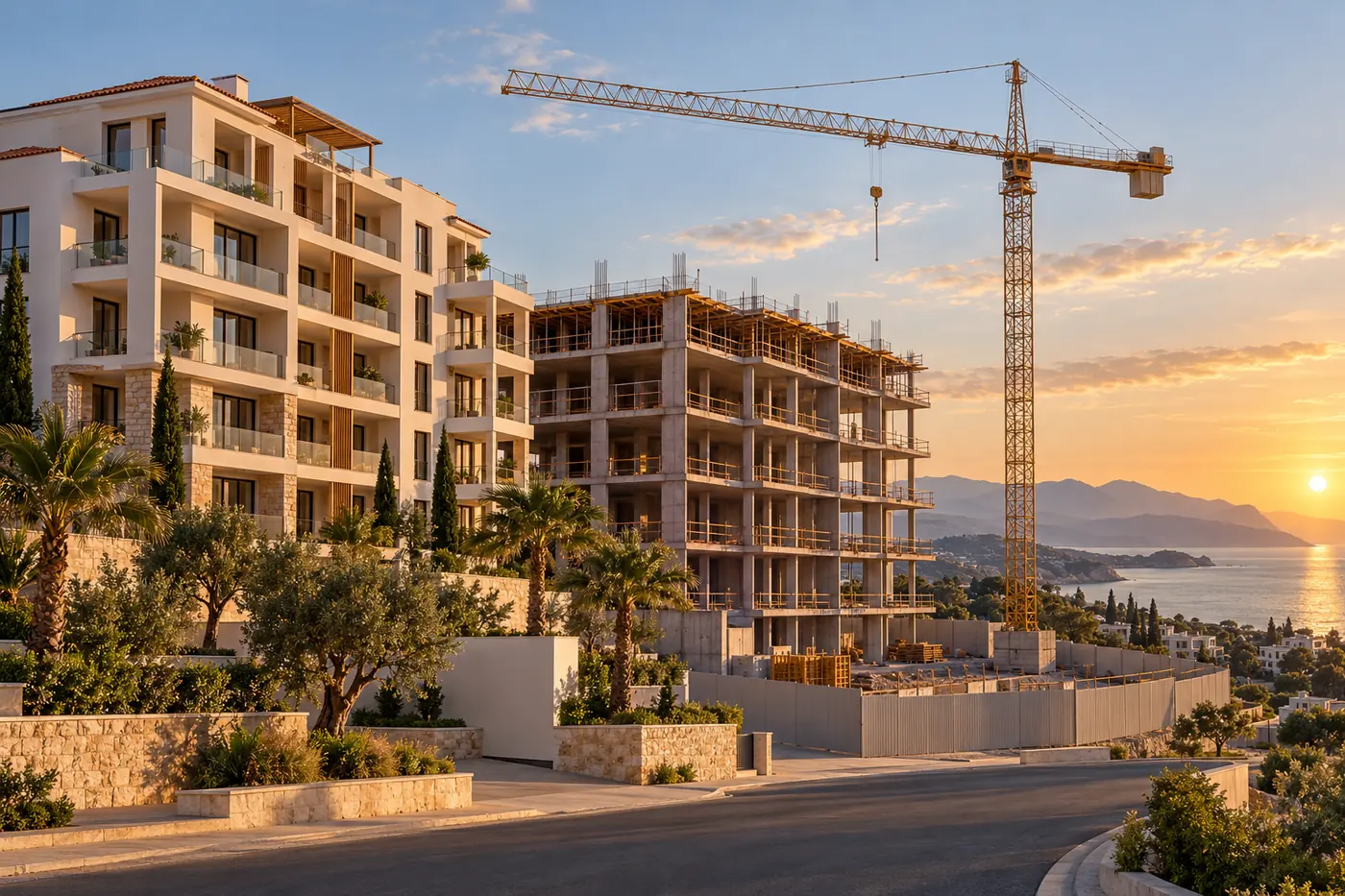
New builds in Antalya and Alanya are often sold off-plan, that is before completion, on payment plans: 35-50% upfront and the rest over 18-24 months with no interest. But many developers give a discount for paying in full (3.5-7% according to listings and portals), so a plan does cost money; it is built into the price.
Typical offers in 2026 (from listings and project pages): 35-50% down, the rest in equal instalments over 18-24 months until completion, no interest. What that costs per year compared with paying in full at a discount, on our calculation. Ask the developer for two prices: on a payment plan and for payment in full.
The real cost of an “interest-free” plan, $200,000 apartment: down payment, term, discount for paying in full
| Terms | Payment | Implied annual cost |
|---|---|---|
| 50%, 18 months, 7% discount | $5,556 | ~21.5% |
| 50%, 18 months, 5% discount | $5,556 | ~14.5% |
| 50%, 18 months, 3.5% discount | $5,556 | ~9.7% |
| 35%, 24 months, 7% discount | $5,417 | ~11.8% |
| 35%, 24 months, 5% discount | $5,417 | ~8.1% |
| 35%, 24 months, 3.5% discount | $5,417 | ~5.5% |
Comparing this with a lira loan at 42-51% a year makes little sense: different currency, different inflation. Compare it with a foreign-currency loan instead.
If a bank quotes 7-12% a year in dollars, a 24-month plan is about the same or cheaper (5.5-11.8% in the table), while an 18-month plan with a 5-7% discount is clearly more expensive (14.5-21.5%). The other difference is the term: you have to pay off the balance within 18-24 months.
Bank mortgage or developer payment plan
| Bank | Developer | |
|---|---|---|
| Down payment | 10% to 80% under the BDDK table; 25-50% at the two banks that publish terms for foreigners | 35-50% |
| Term | up to 120-240 months | 18-24 months, usually until completion |
| Cost of money | 42-51% a year in lira; foreign currency case by case | 0% on paper, about 5-22% a year in dollars via the discount (our calculation) |
| Income check | yes, with apostilled documents | set by the developer |
| Title deed in your name | straight away, with the bank’s mortgage | under current rules, after full payment |
| Property | completed or nearly completed: Ziraat requires at least 90% completion, Akbank 70% | usually off-plan |
How a payment plan works for a foreign buyer
- The withdrawal rights under Consumer Protection Law No. 6502 apply to a consumer, that is, someone buying a home outside a business activity. If you buy to let, whether they apply is ultimately for the courts.
- A notarised preliminary sale contract (a promise of sale, satış vaadi sözleşmesi). Under Law No. 6502 it must be signed before a notary and only once a building permit has been issued; without a valid notarised contract the developer may not take payments. Check both documents before your first payment.
- 14 days to withdraw, without giving a reason or paying a penalty.
- Completion within 48 months of the contract. Within 24 months the buyer can withdraw without giving a reason; the developer may keep up to 2%, 4%, 6% or 8% of the price depending on how much time has passed.
- You can register the preliminary sale contract with the land registry (fee 0.683% of the contract price). Your rights can then be asserted against anyone who later buys the apartment or takes a mortgage on it.
- Under current Central Bank and land registry rules, the title deed is normally issued to a foreign buyer after full payment: a foreigner cannot take the deed now and leave the balance as a charge in the developer’s favour.
- Each payment is made in foreign currency through a bank, with a currency purchase certificate (DAB) for each one.
Under the current version of the rules, a mandatory “secure payment” system for property sales starts: the money and the ownership change hands at the same time through a dedicated system. The loan part of the price does not go through it. The published rules do not say how it will work for foreigners, and the ministry has already moved the start date twice.
Mortgage, residence permit and Turkish citizenship
For citizenship the loan does not count: you need at least $400,000 of your own money in the property. There is no official rule on whether a mortgage affects a residence permit, but on a payment plan the title deed is, under current rules, issued only after full payment, and owners usually wait until then for a property-based permit.
Citizenship by investment, $400,000
You can buy with a loan, but under the land registry guidelines (2024 edition) the loan is deducted from the price: at least $400,000 of your own money must remain. A $500,000 apartment, for example, qualifies only if the loan is no more than $100,000.
A standard developer payment plan does not work for citizenship: under a preliminary sale contract at least $400,000 must be paid upfront under a single contract.
You can buy a property that already carries another bank’s mortgage, but the mortgaged amount is not counted, and a property with a statutory mortgage in the seller’s favour does not qualify. More on the programme: Turkish citizenship by investment.
Property-based residence permit
We found no official rule on whether a mortgage affects a residence permit. The practical limit is different: according to lawyers and migration office practice, owners apply for the permit with the title deed in hand.
On a payment plan the deed is issued only after full payment, so owners usually wait until then. Check the procedure before you buy.
The price threshold and the districts are covered on our Turkish residence permit page and in the article on which Alanya districts are open for residence permits.
What to choose: a short answer for each situation
- You live abroad and earn in pounds, euros or dollars. The realistic options are your own funds or a developer payment plan. Ask 2-3 banks about a foreign-currency mortgage, but expect 50-75% of the valuation (as at Kuveyt Türk and Türkiye Finans), an income check with apostilled documents and a currency risk if your income is not in the loan currency.
- You own a home in your own country. Ask your own bank and a tax adviser whether borrowing at home, in your own currency, is possible and cheaper. Conditions vary by lender, and it may mean securing the loan on your home.
- You live in Turkey with a residence permit and earn in lira. Some banks, such as QNB, say they offer lira mortgages for this, but the land registry’s 2026 letter takes a different position. Before paying anything, get written confirmation from the bank and check that the land registry will accept the deal.
- You need a residence permit quickly. Buy a completed apartment with a title deed using your own funds: on a payment plan you usually wait until full payment.
- You want citizenship. At least $400,000 of your own money in the property; a loan only on top, for a more expensive home.
- You want a long term and a low monthly payment. That is expensive in Turkey right now: lira loans cost 42-51% a year, and a foreign-currency loan is priced case by case.
ANPA Estate has 10+ years in the market, 300+ completed deals and offices in Antalya and Dubai. We find new builds with payment plans to fit your budget and support the purchase together with trusted lawyers: the notary contract, registration with the land registry, payments through the bank.
For mortgages we work through trusted specialists who deal with Turkish banks. See all ANPA Estate services.
Our fee is agreed individually: send us a request and we will shortlist properties for the way you want to pay and work out the payment.
Sources (checked on 30 October 2026)
- Central Bank of Turkey, policy rate decision of 22 October 2026 (press release 2026-45), tcmb.gov.tr.
- BDDK Decision No. 11364 of 29 January 2026 (loan-to-value) and No. 10656 of 24 August 2023 (existing home owners), bddk.org.tr.
- Decree No. 32 on the Protection of the Value of the Turkish Currency, Article 17/A, ms.hmb.gov.tr.
- Central Bank of Turkey, Capital Movements Circular (July 2026), Articles 13 and 43, tcmb.gov.tr.
- Land registry (TKGM): letter on loans to foreigners (published 22 January 2026), citizenship guidelines (as of 9 December 2024), 2026 tariff.
- Consumer Protection Law No. 6502, Articles 40-46, mevzuat.gov.tr.
- Regulation on Real Estate Trade: amendments in the Official Gazette of 29 April 2026 No. 33238 and 1 October 2026 No. 33387.
- Websites of Türkiye Finans, Kuveyt Türk, Garanti BBVA, QNB, İş Bankası, DenizBank, Yapı Kredi, Halkbank, VakıfBank and Akbank (checked on 30 October 2026).
- Central Bank of Turkey exchange rate on 30 October 2026: 49.77 lira per dollar.
This material is for information only and is not legal, tax, credit or investment advice. Rates, fees and requirements can change. Before buying, arranging a mortgage or applying for a residence permit or citizenship, check the current terms with the bank, the land registry (tapu), the migration authority and a qualified adviser.
FAQ
Yes, on the terms that apply to foreigners. Nationality does not set the rules, residency does: whether you legally live in Turkey, not your tax residence elsewhere. Without a Turkish residence permit you can only get a foreign-currency loan from a bank with a non-resident product. One bank, Kuveyt Türk, also limits non-residents to countries on its reciprocity list, so check with the bank for your passport.
Yes, but only in foreign currency under Central Bank rules, and only at banks with a product for non-residents (Türkiye Finans, Kuveyt Türk and Garanti BBVA list one). Expect 50-75% of the valuation at the banks that publish terms, apostilled income documents and a rate quoted case by case.
For Turkish citizens, in lira, mostly 2.95-3.5% per month at the large banks on 30 October 2026, which is 42-51% a year on our calculation; up to 4.03% on some QNB products. Banks do not publish foreign-currency rates for non-residents and quote them after you apply.
Under the BDDK table from 10% to 80% depending on the price and energy class, but of the two banks that publish terms for foreigners Kuveyt Türk lends 50% and Türkiye Finans up to 75%, so expect a down payment of 25% to 50%. If you, your spouse or children under 18 already own a home, the loan limit is four times lower.
Usually cheaper than a lira loan at 42-51% a year. Against a foreign-currency loan it depends on the discount for paying in full: on our calculation a plan with a 3.5-7% discount costs about 5-22% a year in dollars, so a 24-month plan often compares well and an 18-month plan with a large discount does not. Ask the developer for both prices.
Yes. Since 29 January 2026 the BDDK rules do not distinguish new and resale homes: the loan limit depends on the price and energy class. You need a title deed and the bank’s valuation.
Yes, but under the land registry guidelines the loan does not count: you need at least $400,000 of your own money in the property. Once the three-year no-sale restriction is registered on the title, the property can be mortgaged.
Usually up to 120 months; QNB up to 180 and Garanti BBVA up to 240. Banks set a maximum age at the end of the loan, for example 70 at Akbank and 75 at Yapı Kredi.
Find a property that fits how you want to pay
Send us a request: we will shortlist new builds with payment plans or completed apartments within your budget and work out the payment. For mortgages we work through trusted specialists.